What’s Your Opinion On Building With Green Timber?
What’s Your Opinion On Building With Green Timber?
Good morning Joe,
Most of the projects we do are green timbers. Some are are air dried and occasionally we use kiln dried timber when the owner or architect request it. By spec definition, a dried product is somewhere in the 19% moisture content range, and we find that the Douglas Fir timber that we use, once they’ve been milled, shipped, prepped for fabrication, cut, packaged and shipped, are right around the 19% mark.
KD material will have a 15% moisture content 1″ deep into the timber – deeper than that the wood is still green. The KD drying process makes the knots brittle, so they will often break out when the timber is surfaced, which is less attractive. For those reasons we prefer using green timber, but some architects feel strongly about using kiln dried material so we are happy to provide it with Douglas fir. KD timber is not available in oak, pine or hemlock.
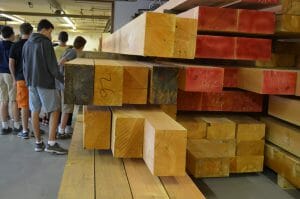
Students Touring the Vermont Timber Works Shop
For timber framing, most material orders are a-la-carte. There are some pretty standard sizes 6×8, 8×8, etc., but each project calls for something different than the last, and in order to fill those needs, we have to have suppliers and mills cut everything as the order is made. That being said, we have some suppliers that have timbers stocked, on “stickers”, which allows the product to dry before it’s sold, but that is not the norm.
You will find that denser woods, i.e. Oak, will never dry the way a Doug Fir or Hemlock will, so over time, as the moisture gradually dissipates from the timber, it is more apt to checking, twisting, etc. All timbers are going to check over time. One way to reduce checking is by using free of heart material. When you think about the rings on a log, the heart is the center of the bullseye. On larger species, like Doug Fir, we’re able to get timbers that are free of the heart (bullseye), and that wood is less susceptible to checking and blemishes.
Here is a link to our site that explains expected blemishes, and free of heart material.
I hope you find this helpful,
Derek
heartwood is not sap wood !Werner
That is absolutely true. Sapwood is the wood just under the bark. It is generally lighter in color and much more wet than heartwood, which is found deeper in the tree. Cheers, Doug